

How a Raspberry Pi CM5, UA Edge Translator, and Web of Things technology can turn legacy industrial assets into modern OPC UA information sources in minutes.
by Erich Barnstedt, Senior Director & Architect Industrial Standards, Corporate Standards Group, Microsoft Corporation
Industrial plants are full of valuable equipment that predates today’s interoperability standards. PLCs, sensors, drives, energy meters, and controllers often speak proprietary or fieldbus protocols, but lack a secure OPC UA interface with rich, discoverable semantics. Traditionally, connecting these systems to enterprise IT, cloud applications, digital twins, or Industry 4.0 initiatives required costly gateway hardware, custom software development, or lengthy integration projects.
Today, that has changed.
Using the OPC Foundation’s open-source UA Edge Translator, a Raspberry Pi Compute Module 5 (CM5), and standardized Web of Things (WoT) descriptions, you can deploy a complete industrial edge gateway for approximately $200 USD, automatically onboard brownfield assets, and expose them through a standards-based OPC UA information model in less than ten minutes.
The Hardware
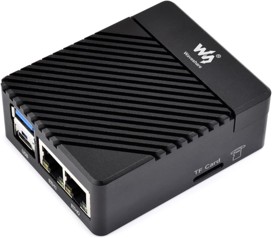
For this deployment, we use:
- Industrial-grade Raspberry Pi CM5
- 4 GB RAM
- 16 GB eMMC
- Waveshare Mini Dual Gigabit Ethernet Board
- Included industrial enclosure
- Included power supply
The total hardware cost is approximately:
| Component | Approximate Cost | |
| CM5 4GB/16GB eMMC | $150 | |
| Waveshare Dual Ethernet Kit | $50 | |
| Power Supply and Enclosure | Included | |
| Total | $200 |
For an industrial gateway that includes dual Ethernet interfaces, solid-state eMMC storage, and OPC UA connectivity, this represents a fraction of the cost of traditional industrial edge hardware.
The CM5’s onboard eMMC storage is particularly attractive for remote installations because it offers significantly higher reliability than microSD cards while requiring no additional storage devices.
Step 1: Install the Raspberry Pi 5 Compute Module
Follow the assembly guide here.
Step 2: Flash the Raspberry Pi OS
Install Raspberry Pi OS Lite on the CM5’s eMMC using Raspberry Pi Imager and Raspberry Pi USB Boot from your PC. Run rpiboot and plug the device directly (i.e. no USB hubs in the middle!) into a USB port while holding down the “Boot” button on the device. It will then show up as a mass storage device on your PC. When imaging the device, enable SSH and configure the hostname (“edgegateway”) and use the default username (“pi”). Connect one Ethernet port to your asset network and the other to your OT network, i.e. a typical gateway setup. After booting the device, login into the device:
ssh pi@edgegateway
Update the system:
sudo apt update && sudo apt upgrade -y
Verify connectivity:
ping github.com
At this point you have a fully operational industrial gateway.
Step 3: Install K3s, a lightweight Kubernetes distribution
UA Edge Translator is containerized and designed to run on Kubernetes.
Enable cgroup memory:
sudo sed -i ‘1 s/$/ cgroup_memory=1 cgroup_enable=memory/’ /boot/firmware/cmdline.txt
Reboot:
sudo reboot
Log back in again and install K3s:
curl -sfL https://get.k3s.io | sh –
Verify installation:
sudo kubectl get pods -A
Step 4: Deploy the free-to-use, MIT-licensed UA Edge Translator
The OPC Foundation publishes a ready-to-use deployment manifest. Download it:
wget https://raw.githubusercontent.com/OPCFoundation/UA-EdgeTranslator/main/UA-EdgeTranslator.yaml
Update the username and password in the deployment file:
Nano UA-EdgeTranslator.yaml
Then deploy it:
sudo kubectl apply -f UA-EdgeTranslator.yaml
Step 5: Open the UI and Upload a Web of Things (WoT) File
The UA Edge Translator includes a web-based management interface. It is accessible from a web browser pointed at the device’s IP address from anywhere on the network. Similarly, the OPC UA server interface UA Edge Translator provides is available at the default OPC UA port 4840 at the device’s IP address.
The user interface allows operators to:
- Upload Thing Descriptions
- Inspect loaded protocol drivers
- Inspect asset connection status
- Browse generated OPC UA asset mappings
- Manage OPC UA security certificates
No software development is required.
A maintenance technician, controls engineer, or OT specialist can perform onboarding directly from a browser.
The secret behind the rapid onboarding process is the use of W3C Web of Things Thing Descriptions.
Instead of manually mapping tag-by-tag through a custom UI, you simply describe:
- The asset
- Its variables
- Protocol connection details
- Data types
- Metadata
The translator then automatically:
- Connects to the underlying asset
- Reads data through the native protocol
- Generates OPC UA data variables in its information model
- Exposes the asset through an OPC UA server
This dramatically reduces engineering effort. Ask for a WoT file from your asset vendor today!
Pro Tip: Generating the WoT File
If the WoT file is not available for your asset, you can simply generate one with the help of Agentic AI. The UA Edge Translator documentation on GitHub describes several ways on how Thing Descriptions can be generated. The resulting Thing Description becomes the single source of truth describing the asset.
From Brownfield to Digital Twins with Standardized Semantic Meaning
Once the asset is exposed through OPC UA, it becomes immediately consumable by:
- MES systems
- SCADA applications
- Historians
- OPC UA clients
- Manufacturing data hubs
- Cloud platforms
- Digital twin environments
- AI and analytics applications
The same data can feed both operational systems and cloud-native architectures.
This is precisely the goal of the OPC Foundation Cloud Initiative: enabling a scalable, standards-based path from brownfield industrial equipment to modern cloud and AI solutions without requiring expensive rip-and-replace projects.
Conclusion
For only $200, a Raspberry Pi CM5 and UA Edge Translator provide a complete industrial interoperability gateway that can transform legacy assets into secure, OPC UA-enabled information sources in minutes. The result is a lightweight, open, standards-based edge platform that dramatically reduces the cost and complexity of onboarding brownfield assets while preserving existing investments in industrial equipment.