


 go back
Scope / Goals
The “Weihenstephan Standards (WS)” are domain-specific communication interfaces for the food and packaging industry. One of the strengths of the Weihenstephan Standards is their explicit focus on individual domains.
For each domain, the Weihenstephan Standards provide domain-specific recommendations for data evaluation and reporting on higher-level IT systems.
The working group first developed the Companion Specification OPC 40600 – OPC UA for Weihenstephan Standards. A significant focus of it is backward compatibility with the models of the Weihenstephan Standards, which have been used in the industry for many years.
Backward compatibility is no longer a requirement. The working group will develop a new multi-part specification with a “real” type-based OPC UA information model.
The intended structure is as follows:
-
In the first part “WS Basics”, a generic WS MachineType and commonly usable components will be defined.
-
In the domain-specific parts , e.g., WS Sweets, the machines of the respective domain will be defined, e.g., a moulding plant. Naturally, matching types of other CS will be reused as part of the harmonization process.
Technical overview
The scope of the Working Group is the creation of OPC UA Companion Specifications (CS) for the existing “Weihenstephan Standards”, e.g. WS Food, Pack, Bake, Brew. The Weihenstephan standards cover different domains, such as packaging and food processing machinery, whose special machines show almost no similarities. Since these machines also need different permutations of data sets available in the information model, it is not possible to describe one single OPC UA information model that is valid for all special machines within the domain of packaging and food machinery.
As a conclusion, the planned CS does not provide a complete domain specific OPC UA information model, but rather a generic methodology how these tags within these standards have to be mapped into the OPC UA address space. The data types needed for this mapping and the generic part of the information model, which is not specific to the individual Weihenstephan Standards, will be described in the CS. WS templates specify, depending on the domain under consideration, data points for individual machines. Figure 1 shows the layer model of the WS.
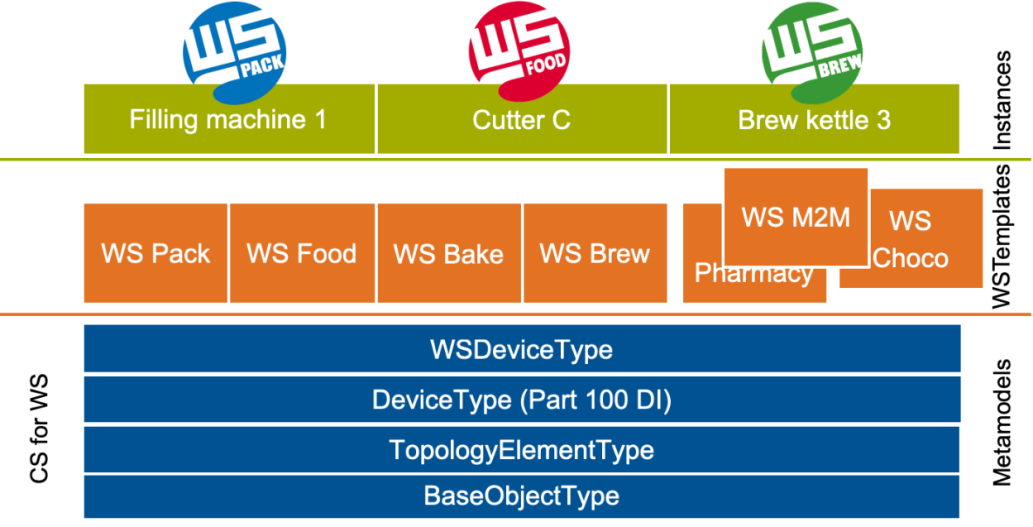
Due to the special situation of the Weihenstephan Standards, which describes special machines in different domains, a new document structure (see figure 2) had to be introduced.

Working Group Type
Joint
Status
Active
Chair(s)
Collaboration Partner(s)

Classification(s)
Enterprise - Asset Mgmt - Packaging, Factory Automation, Process Automation